
ePTFE vent membranes are used in packaging, electronics, automotive components, industrial equipment, lighting products, and sealed containers. They help equalise pressure while providing protection against water, dust, oil, and other contaminants.
Below are common questions about breathable vent membranes, vent liners, adhesive vent patches, and customised ePTFE venting solutions.
What is an ePTFE vent membrane?
An ePTFE vent membrane is a microporous material designed to allow air and gases to pass through while helping block liquids, dust, and contaminants. ePTFE stands for expanded polytetrafluoroethylene.
The membrane is commonly used in sealed enclosures and packaging systems where pressure equalisation is needed without creating an open path for water or dust.
How does an ePTFE vent membrane work?
The membrane contains millions of microscopic pores. These pores are large enough for air and gas molecules to move through but small enough to help block water droplets, dust particles, and many external contaminants.
When installed on a bottle cap, electronic enclosure, sensor housing, or lighting product, the membrane helps balance internal and external pressure.
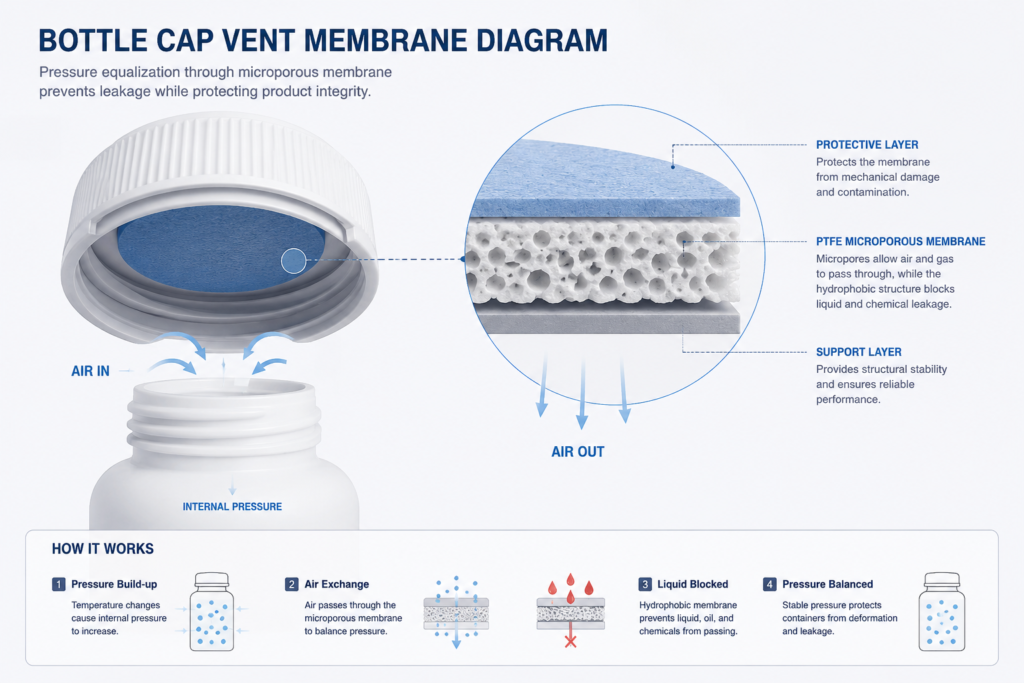
Can ePTFE vent membranes prevent water leakage?
ePTFE vent membranes can help prevent water and liquid leakage when correctly selected and integrated into the product design. The membrane creates a breathable barrier that allows gas exchange while helping block liquid penetration.
For chemical bottles and agrochemical packaging, vent membranes are often integrated into caps, vent liners, induction seals, or closure systems to reduce pressure-related leakage risks.
What products can use ePTFE vent membranes?
ePTFE vent membranes are suitable for many products, including:
- Agrochemical bottles and chemical containers
- Fertiliser packaging and liquid product closures
- Outdoor LED lights and lighting enclosures
- Automotive sensors and electronic modules
- Battery packs and battery management systems
- Telecom equipment and communication devices
- Industrial control boxes and electrical enclosures
- Medical devices and laboratory containers
- Consumer electronics and smart home devices
What is the difference between a vent patch and a vent liner?
A vent patch is usually an adhesive-backed ePTFE membrane applied directly to an enclosure surface. It is commonly used for electronics, sensors, lighting products, battery packs, and sealed equipment housings.
A vent liner is usually integrated into a bottle cap, closure, induction seal, or container lid. It is commonly used for agrochemical bottles, industrial chemical packaging, fertiliser containers, and liquid product packaging.
Can ePTFE vent membranes be used for outdoor electronics?
Yes. ePTFE vent membranes are widely used in outdoor electronic products because they help manage pressure changes caused by heating, cooling, sunlight, rain, humidity, and changing weather conditions.
They can help reduce condensation risks inside LED lights, security cameras, automotive sensors, telecom equipment, battery enclosures, and industrial control systems.
Can ePTFE vent membranes support IP-rated enclosure designs?
ePTFE vent membranes can support waterproof and dust-resistant enclosure designs. However, the final IP rating depends on the complete product structure, including the housing material, vent location, adhesive system, sealing method, installation process, and testing conditions.
It is important to test the complete enclosure after the vent membrane is installed.
Can the membrane size and shape be customised?
Yes. ePTFE vent membranes can be customised in different sizes, shapes, airflow levels, membrane thicknesses, adhesive systems, and backing materials.
Common shapes include round vent patches, rectangular vent patches, strips, die-cut parts, cap inserts, vent liners, and custom membrane assemblies.
How do I select the right vent membrane for my product?
The correct vent membrane depends on the application. Important factors include enclosure volume, pressure changes, airflow requirements, operating temperature, exposure to water or chemicals, housing material, installation area, and required protection level.
For chemical packaging, chemical compatibility and liquid surface tension should also be considered. For electronic enclosures, pressure equalisation speed, waterproof performance, adhesive strength, and installation position are important.
Can Ventrase provide custom venting solutions?
Yes. Ventrase provides ePTFE vent membrane solutions for packaging, agrochemical bottles, electronics, automotive components, battery packs, outdoor lighting, industrial equipment, and sealed enclosures.
We support custom vent patch sizes, vent liner structures, membrane airflow levels, adhesive options, die-cut shapes, and product integration requirements.
Where can I find more ePTFE vent membrane information?
For product applications, technical resources, and venting solution updates, visit Ventrase Resources.