
What Is ePTFE Membrane? Structure, Properties and Applications
An ePTFE membrane is a microporous material made from expanded polytetrafluoroethylene. It is widely used in applications that require air or gas exchange while helping prevent liquid water from entering. Its unique structure makes it a valuable material for waterproof breathable venting, pressure equalization, and protective applications.
For packaging and industrial products, pressure changes can create practical problems. A sealed container may deform as temperature or altitude changes, while moisture and contaminants may need to be kept out. An appropriately selected ePTFE membrane can help address these challenges by allowing controlled gas exchange.
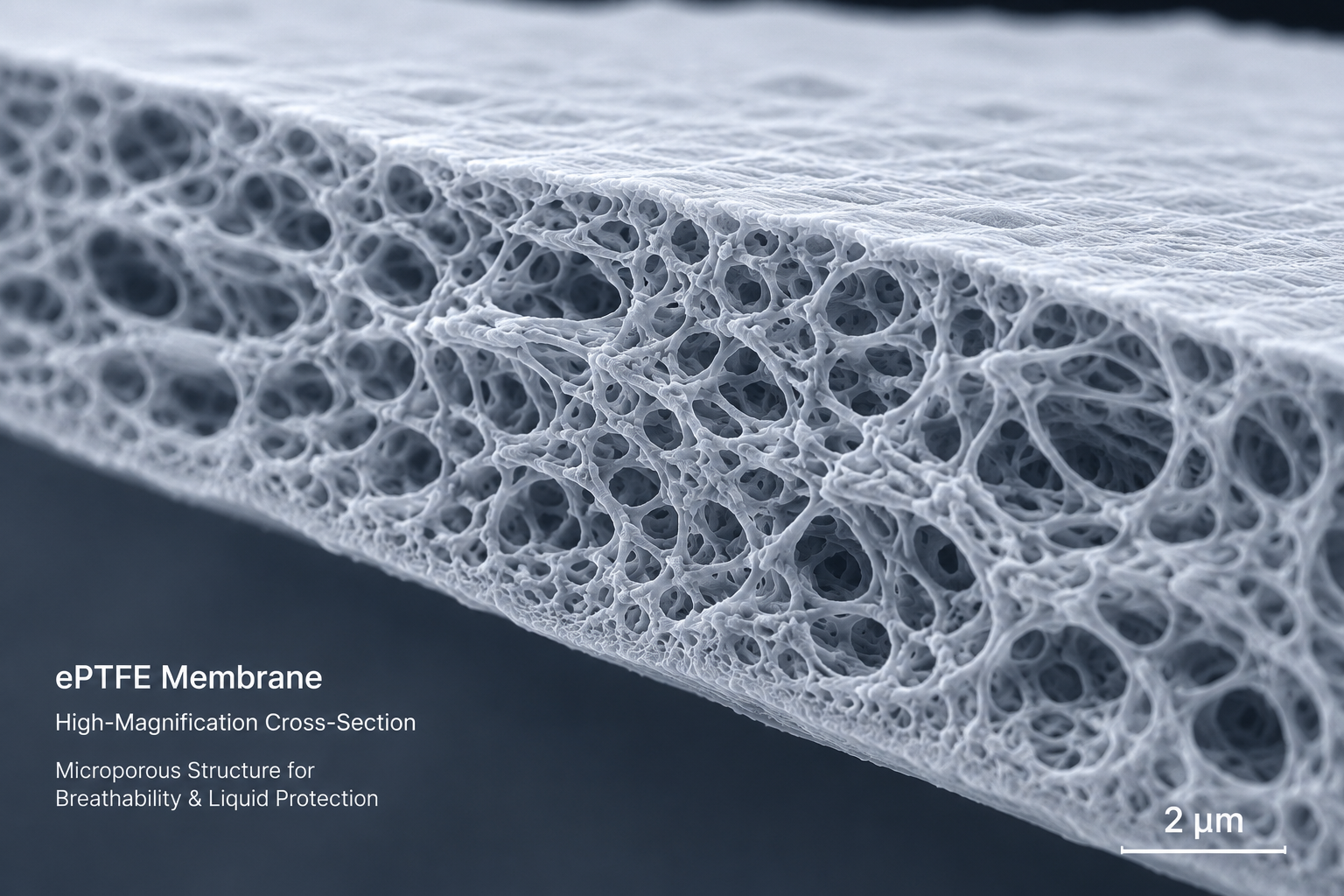
Image suggestion: ePTFE membrane material or a close-up of its microporous structure.
1. What Is ePTFE Membrane?
ePTFE stands for expanded polytetrafluoroethylene. It is produced by expanding PTFE under controlled conditions to create a microporous structure.
The resulting membrane contains a network of microscopic pores. These pores can allow air and other gases to pass through while resisting the entry of liquid water, depending on the membrane design and operating conditions.
Unlike a conventional solid film, ePTFE membrane is designed to provide a balance between protection and gas permeability. This makes it suitable for products that need to breathe without being fully exposed to the surrounding environment.
2. How Does the ePTFE Membrane Structure Work?
The performance of ePTFE membrane comes from its microporous structure and the properties of PTFE.
Microporous structure
Expansion creates a network of interconnected pores. Gas molecules can move through this structure, while liquid water is resisted by the membrane’s pore characteristics and surface properties.
Hydrophobic properties
PTFE is naturally hydrophobic, meaning it repels water. This property helps an appropriately designed ePTFE membrane resist liquid water penetration while allowing gas exchange.
Controlled gas exchange
When pressure changes occur inside a container or enclosure, gas can move through a suitable vent membrane. This helps reduce pressure differences between the inside and outside environment.

Image suggestion: a simple technical diagram showing gas exchange and water resistance.
3. Key Properties of ePTFE Membrane
| Property | What It Means | Why It Matters |
|---|---|---|
| Air permeability | Allows air or gas to pass through the membrane. | Supports pressure equalization and ventilation. |
| Water resistance | Resists liquid water penetration when designed for the required conditions. | Helps protect enclosed components or packaging. |
| Hydrophobicity | Repels water due to the material’s surface properties. | Supports breathable, water-resistant performance. |
| Chemical resistance | PTFE is resistant to many chemicals, but the complete vent assembly must be evaluated. | Important for chemical packaging and industrial environments. |
| Pressure equalization | Allows gas exchange to help reduce pressure differences. | Can help reduce container deformation caused by pressure changes. |
For a specific application, membrane performance should be confirmed using technical data and testing under relevant operating conditions.
4. Common Applications of ePTFE Membrane
Waterproof breathable products
ePTFE membrane is used in products that require protection from liquid water while allowing moisture vapor or gas exchange. The exact performance depends on the membrane construction and product design.
Electronic and electrical enclosures
Pressure changes inside sealed enclosures can place stress on seals and housings. A suitable vent membrane can help equalize pressure while providing a barrier against environmental contaminants.
Automotive components
Automotive lighting and electronic components may experience temperature and pressure changes. Venting solutions can help manage these changes while supporting protection against water and dust.
Chemical and agrochemical packaging
Some liquid products can generate pressure changes during storage, transportation, or temperature variation. An ePTFE vent plug or vent liner can help provide controlled gas exchange when properly selected for the packaging and chemical.
Learn more about selecting a suitable vent plug for chemical packaging.
Image suggestion: an ePTFE vent plug installed in a chemical container cap.
5. ePTFE Membrane vs. Conventional PTFE Film
Both ePTFE and conventional PTFE are based on polytetrafluoroethylene, but their structures and intended functions can differ.
| Feature | ePTFE Membrane | Conventional PTFE Film |
|---|---|---|
| Structure | Expanded microporous structure | Typically dense or non-expanded structure |
| Gas permeability | Can be designed to allow gas exchange | Generally limited when the film is nonporous |
| Typical function | Breathable venting and protective applications | Sealing, insulation, and chemical-resistant barrier applications |
| Selection focus | Airflow, water resistance, pore structure, and application conditions | Thickness, sealing, mechanical properties, and chemical compatibility |
The correct material depends on whether the application requires gas exchange, a solid barrier, or a combination of functions.
6. How to Select the Right ePTFE Membrane
When choosing an ePTFE membrane for an industrial or packaging application, consider the following factors:
- Required airflow: Determine how quickly pressure needs to equalize.
- Water resistance: Confirm the required water entry pressure and test conditions.
- Chemical compatibility: Evaluate the membrane, housing, adhesive, and other components together.
- Operating environment: Consider temperature, humidity, pressure changes, and exposure conditions.
- Installation method: Check whether the membrane will be integrated into a vent plug, liner, enclosure, or other assembly.
- Testing requirements: Confirm which performance tests are needed for the finished product.
For packaging applications, the complete vent assembly should be evaluated rather than selecting a membrane based on one property alone.
7. ePTFE Membrane for Vent Plug and Vent Liner Applications
In packaging, ePTFE membrane can be incorporated into vent plugs or vent liners to support pressure equalization. The design may vary according to container size, closure structure, product chemistry, and required performance.
Explore Ventrase solutions:
For more technical information about membrane materials and venting concepts, visit the Ventrase technical resource website.
Frequently Asked Questions
Is ePTFE membrane waterproof?
An appropriately designed ePTFE membrane can resist liquid water while allowing gas exchange. Its water resistance depends on the membrane specification, construction, and test conditions.
Does ePTFE membrane allow air to pass through?
Yes. ePTFE membrane can be designed to allow air or gas to pass through its microporous structure. The airflow rate depends on the membrane and test conditions.
Is ePTFE membrane chemically resistant?
PTFE is resistant to many chemicals. However, chemical compatibility should be evaluated for the complete assembly, including the membrane, housing, adhesive, and sealing materials.
What is the difference between ePTFE membrane and an ePTFE vent plug?
ePTFE membrane is the functional material that provides breathable protection. An ePTFE vent plug is a finished component that incorporates a membrane into a housing for installation in a container or enclosure.
Can ePTFE membrane be used for chemical packaging?
Yes, it can be used in suitable chemical packaging venting applications. The membrane and finished vent assembly must be selected and tested for the specific chemical, container, and operating conditions.
Looking for an ePTFE Membrane Venting Solution?
Ventrase provides ePTFE vent plugs and venting solutions for packaging and industrial applications. Share your container design, application, and performance requirements with our team.
Technical note: Product performance should be confirmed using the applicable technical data, test methods, and application-specific validation.